
Improving at golf rarely comes from hitting more balls without a plan. Golf rewards consistency, decision-making, distance control, and the ability to repeat useful movements under pressure. If you want to know how to get better at golf, the most effective approach is to combine focused practice with better fundamentals and realistic goals. That means working on your setup, ball striking, short game, putting, and course management instead of spending every session trying to hit longer drives. Professional instruction can also help because a coach can identify swing problems that are difficult to notice on your own.
Technology such as launch monitors and simulators can add useful feedback by showing what the ball actually did after impact. Improvement still takes time, but practice becomes much more productive when every session has a clear purpose. The goal is not to build a perfect-looking swing. It is to develop a reliable golf game that produces better shots and lower scores.

How To Get Better At Golf With A Clear Practice Plan
The first step in learning how to get better at golf is replacing random practice with structured practice. Many golfers arrive at the range, hit dozens of balls with the same club, and judge success by whether a few shots look good. That approach can be enjoyable, but it does not always transfer effectively to the course. A better session includes a warm-up, one or two technical priorities, distance-control work, short-game practice, and several realistic target-based shots.
The PGA of America recommends practicing with a clear purpose rather than simply repeating swings. One useful approach is to spend more time on the shots you actually encounter during rounds. If your biggest scoring problems come from wedges, chips, or putting, your practice schedule should reflect that. Track simple results such as fairway targets hit, putts made from a chosen distance, or approach shots finishing within a target area. Measuring performance makes progress easier to recognize and gives each session a specific objective.
Build A More Reliable Setup And Alignment
A consistent swing becomes much harder when your setup changes from shot to shot. Grip, posture, ball position, alignment, and distance from the ball all influence what happens during the swing. Before making complicated mechanical changes, check whether your basic setup gives you a realistic opportunity to strike the ball well. Small alignment errors can make a good swing produce a poor result because the golfer is aimed somewhere other than the intended target.
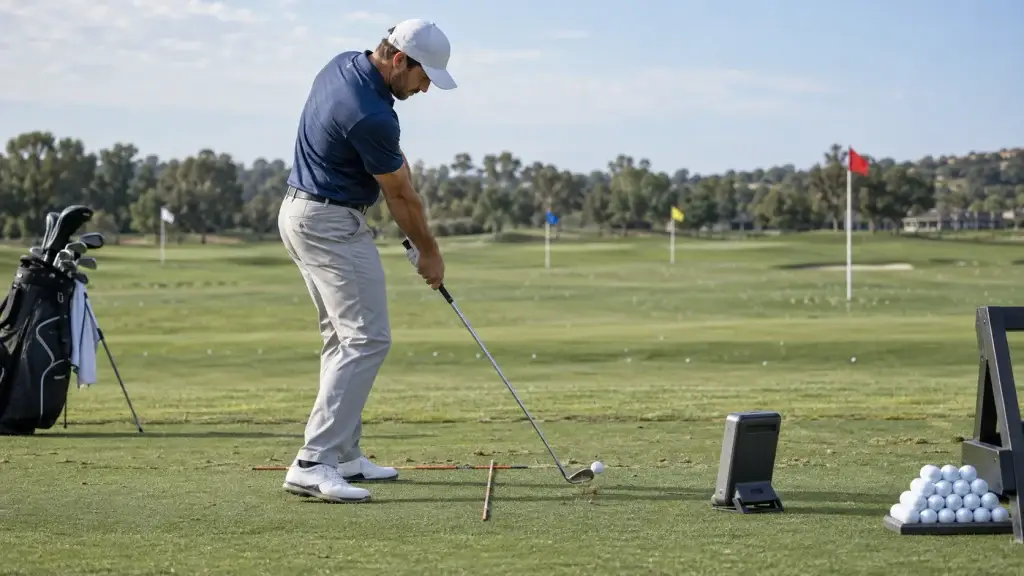
Alignment sticks are one of the simplest tools for golfers working on how to get better at golf. Place one along the target line and another parallel to it near your feet. This provides immediate feedback about where the clubface and body are aimed. The PGA of America identifies alignment and setup work as useful fundamentals for improving ball striking. Regularly checking these basics can prevent compensations from becoming part of your normal swing.
Improve Contact Before Chasing More Distance
Many golfers immediately focus on swing speed because longer shots seem like the fastest path toward better golf. Distance can certainly help, but extra speed provides limited value when contact is inconsistent. Centered contact allows the club to transfer energy more efficiently while producing more predictable launch and direction. With irons, learning to strike the ball before the ground is especially important for controlling carry distance.
If you are learning how to get better at golf, pay attention to where the club contacts both the ball and the turf. Simple drills can reveal whether the low point of your swing occurs in the correct place. You can also use impact spray or another suitable feedback method on the clubface to see where the ball is being struck. Start at a comfortable speed rather than swinging as hard as possible. Once contact becomes more reliable, gradually increase speed while trying to preserve the same strike quality. Reliable contact usually improves both distance and accuracy at the same time.
Spend More Practice Time On The Short Game
Golfers often spend most of their practice time on full swings because hitting drivers and irons is satisfying. However, scoring depends heavily on what happens closer to the green. Chips, pitches, bunker shots, and short putts regularly determine whether a missed green becomes a par, bogey, or something worse. Developing a dependable short game can lower scores even when the full swing is not performing perfectly.
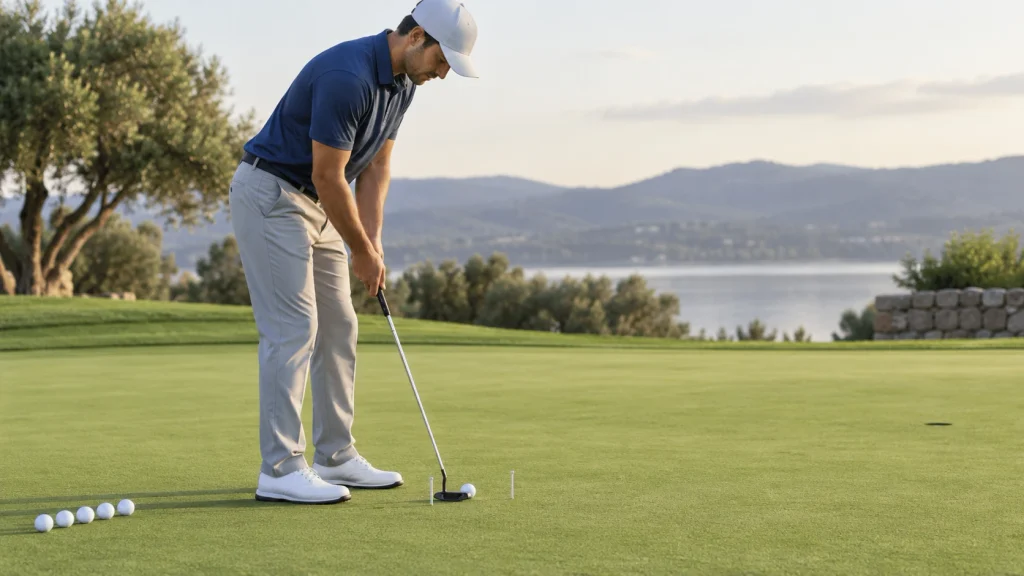
One practical way to improve is to create different landing zones around a practice green. Hit several chips toward each zone using different clubs and trajectories. Then practice short putts from several directions instead of repeatedly putting from the same location. Anyone serious about how to get better at golf should practice both technique and decision-making. Learn when to use a low-running chip, when additional loft is useful, and how far the ball rolls after landing. Better short-game judgment can save strokes without requiring major swing changes.

Learn Your Real Club Distances
Many golfers choose clubs based on the distance of their best-ever shot rather than their normal carry distance. This creates unnecessary trouble because perfectly struck shots do not happen every time. A better strategy is to understand realistic averages for each club. Knowing those distances makes approach decisions easier and helps identify gaps where two clubs travel almost the same distance or where there is too much separation.
Modern technology can make this part of learning how to get better at golf much easier. Launch monitors can measure carry distance, ball speed, launch conditions, and other useful information. A golf simulator can provide this type of feedback while allowing players to hit repeated shots in a controlled setting. Record several reasonable strikes with each club rather than keeping only the longest one. Building a simple distance chart gives you better information on the course and helps reduce avoidable mistakes caused by choosing the wrong club.
Practice With Targets Instead Of Hitting Aimlessly
Every meaningful golf shot has a target, so practice should include targets too. Instead of hitting ten balls with the same iron toward the middle of a range, choose a specific flag, landing area, or imaginary fairway. Go through your normal pre-shot routine and treat each ball as a separate shot. This creates a closer connection between practice and actual play because you have to align, commit, swing, and then evaluate the result.
Adding consequences can make the session even more useful. Give yourself one point for hitting the target area and track your score over ten shots. You can do the same thing with chips, putts, or drives. The PGA of America recommends adding games and challenges to practice because they encourage focus and make sessions more engaging. When figuring out how to get better at golf, this type of practice can reveal whether a technique still works when you have only one attempt instead of unlimited repetitions.
Improve Course Management And Shot Selection
You do not need a better swing to make every improvement in your score. Better decisions can save strokes immediately. Many golfers lose shots by aiming at dangerous pins, attempting recovery shots with very low success rates, or choosing a club that brings unnecessary hazards into play. Course management means choosing a target that balances potential reward against realistic risk based on your own abilities.
This is an important part of how to get better at golf because a technically good player can still score poorly with bad decisions. Before each shot, identify major trouble such as water, bunkers, trees, or out-of-bounds areas. Consider where your common miss would finish. Sometimes aiming toward the middle of a green is better than attacking a flag near the edge. After a poor tee shot, returning the ball safely to play may be smarter than attempting a difficult shot through a narrow opening. Good golf requires knowing when to be aggressive and when to accept a safer option.
Conclusion
Learning how to get better at golf requires more than hitting a large number of practice balls. Focus on reliable fundamentals, centered contact, short-game skills, realistic club distances, target-based practice, and smarter decisions on the course. A structured routine makes it easier to identify weaknesses and measure whether your practice is actually producing improvement.
Technology can also make practice more useful by providing immediate information about your shots. Launch monitors and simulators help golfers understand distance, direction, and ball flight while creating an engaging environment for practice and competition. Roaming Scores brings mobile golf simulator experiences directly to events across Northeast Ohio, allowing guests to hit shots, compete, and enjoy golf in a flexible setting beyond the traditional course.