
Launch monitors turn the first moments of a golf shot into measurable data. Using high-speed cameras, radar, or a combination of sensing technologies, they observe what happens immediately after the club strikes the ball and convert that information into numbers such as ball speed, launch angle, spin, direction, and estimated carry distance. When golfers ask how do golf launch monitors work, the key idea is that the device does not need to watch the ball travel hundreds of yards. It captures the launch conditions that determine the flight, then software uses those measurements to calculate what happens next.
Some systems also track the golf club, providing information about club speed, path, face angle, and attack angle. Understanding which measurements are directly observed and which are calculated makes launch-monitor data much easier to interpret.
What A Golf Launch Monitor Actually Measures
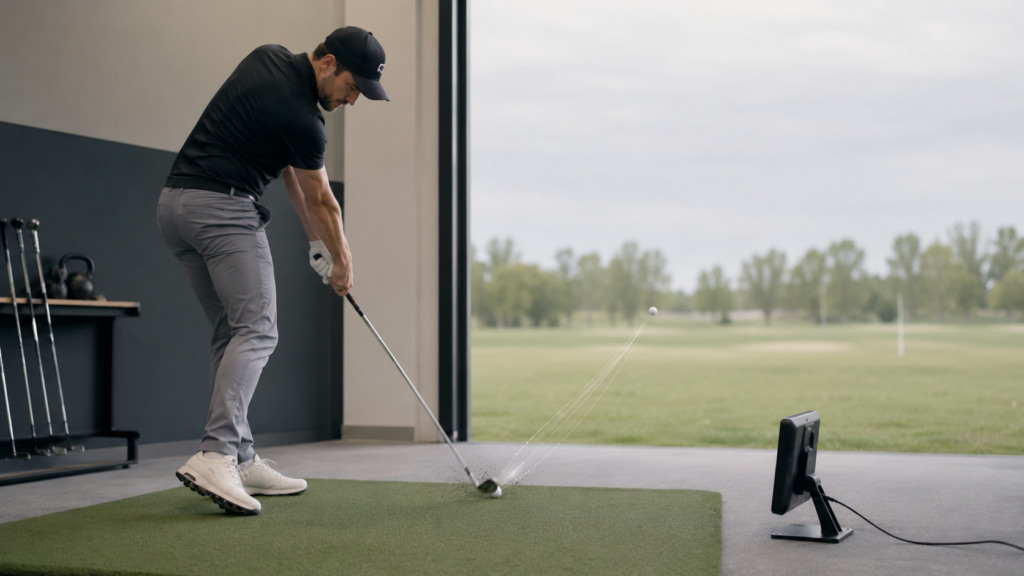
A launch monitor begins working during the brief period surrounding impact. The golf ball may remain near the clubface for only a tiny fraction of a second, but modern sensors can collect enough information during and immediately after that moment to describe the beginning of the shot. Depending on the device, directly measured information can include ball speed, launch angle, horizontal launch direction, spin rate, spin axis, and other variables.
This explains the foundation of how do golf launch monitors work. Instead of attempting to follow the ball from the tee all the way to its landing point, the system measures the conditions that determine the flight. A ball launched quickly at a particular angle with a particular amount and direction of spin will behave differently from a slower ball with different launch conditions.
The monitor then sends those measurements to software. The software can calculate carry distance, peak height, descent angle, lateral movement, and total distance using the measured information along with environmental assumptions. Some systems allow temperature, elevation, wind, or other conditions to be adjusted, which can change the resulting virtual shot.
Golfers researching how do golf launch monitors work should therefore distinguish between measured and calculated numbers. Ball speed may be directly observed, while a value such as total distance may depend partly on mathematical modeling and software settings.
This distinction is important when comparing launch monitors. Two devices may display many of the same numbers while arriving at some of them differently. Knowing what a particular monitor measures directly helps golfers decide whether it provides the information needed for practice, club testing, fitting, or simulator play.
Camera-Based Launch Monitors Capture The Moment Of Impact
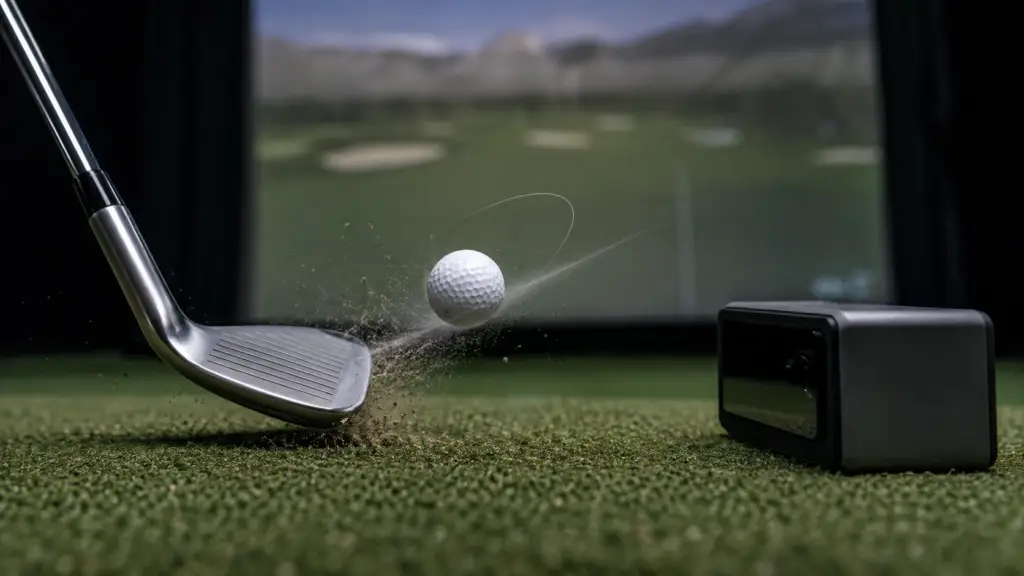
Camera-based launch monitors, often called photometric systems, use high-speed imaging to observe the golf ball around impact. Cameras take a rapid sequence of images as the ball leaves the clubface. Software analyzes changes in position and markings between those images to determine characteristics such as speed, launch direction, launch angle, and spin.
This is one important answer to how do golf launch monitors work indoors. Because the cameras concentrate on a relatively small area near the hitting position, they do not necessarily need to observe a long section of ball flight. That can make camera-based systems practical for garages, basements, simulator rooms, and other spaces where total depth is limited.
Spin measurement can involve watching recognizable features or markings on the golf ball rotate from one frame to another. Some systems work with ordinary golf balls, while others may perform best with specific markings or reflective elements. The exact method varies according to the launch monitor. Camera systems may also observe the golf club before, during, or after impact. When club tracking is available, software can derive information about clubhead speed, path, attack angle, face orientation, and where the ball contacted the face.
Understanding how do golf launch monitors work with cameras also explains why lighting and device placement can matter. The cameras need a clear view of the hitting zone, and the ball must be positioned where the sensors expect it. A sophisticated monitor placed incorrectly can produce weaker results than the same unit operating in its intended environment. Camera tracking is particularly well suited to simulator setups because measurement takes place close to impact and the ball can strike the screen only a short distance away.
Radar Launch Monitors Use Motion And Doppler Shift
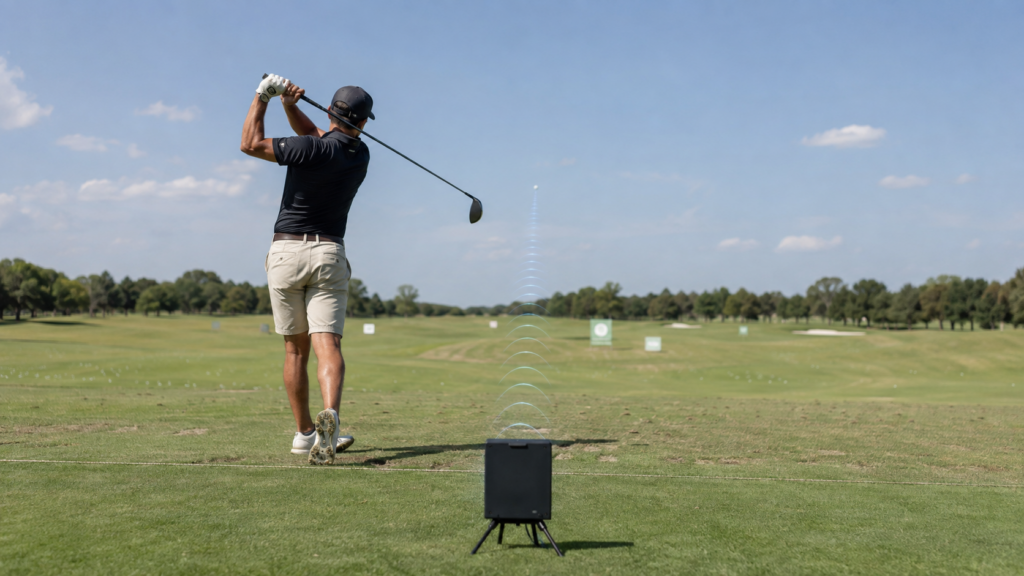
Radar-based launch monitors take a different approach. They transmit radio waves and analyze the signals that return after interacting with a moving target. Movement changes characteristics of the returned signal, allowing the system to estimate motion and speed. This principle is known as the Doppler effect.
The concept is not unique to golf. The National Oceanic and Atmospheric Administration explanation of Doppler radar describes how radar sends radio signals and analyzes reflected energy to determine the distance and velocity of targets. Doppler radar uses changes in the returned signal to identify motion.
That same physical principle helps explain how do golf launch monitors work when radar technology is involved. A golf launch monitor directs radar toward the hitting area and target line, then analyzes the moving club and golf ball. From that information, the device can determine or derive several shot characteristics.
Radar systems can be especially useful outdoors because they may have substantial ball flight available to track. Indoors, however, room dimensions become more important. Certain radar launch monitors need enough distance behind the golfer and enough ball travel between the hitting position and impact screen to collect reliable information.
This is why understanding how do golf launch monitors work should happen before buying equipment for a particular room. A highly capable radar monitor may perform well outdoors but require more indoor depth than a camera-based unit. Neither camera nor radar technology is automatically better in every situation. The better choice depends on available space, desired measurements, portability, budget, and whether the monitor will primarily be used indoors or outdoors.
Software Turns Launch Data Into A Complete Ball Flight
The launch monitor measures the beginning of the shot, but simulator software creates what golfers see afterward. Once ball speed, launch direction, launch angle, spin, and other available measurements are collected, software applies a ball-flight model to predict the trajectory.
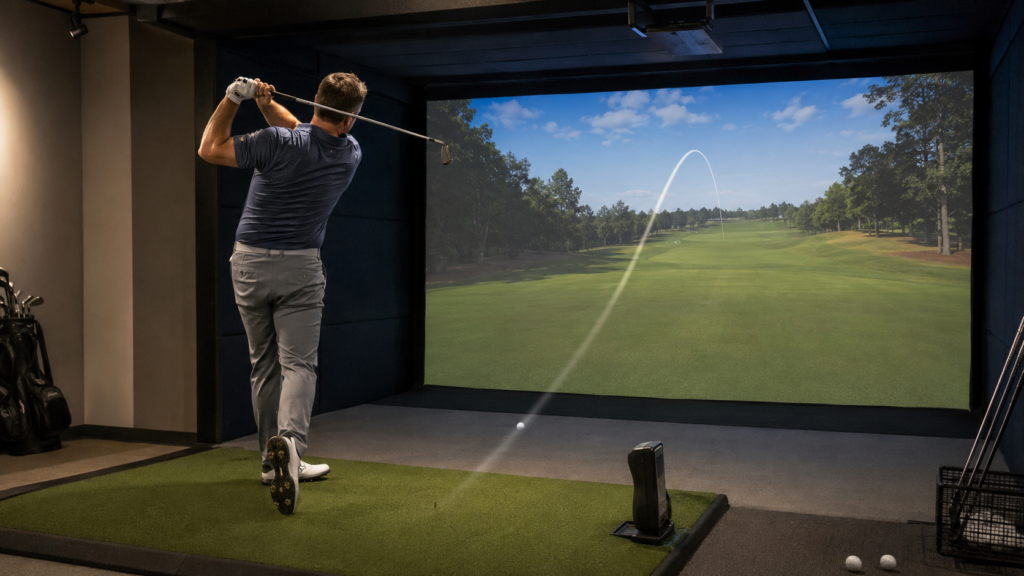
This calculation helps answer how do golf launch monitors work inside a simulator. The golf ball may physically travel only several feet before striking an impact screen, yet the projected shot can continue for 250 yards on a virtual course. The computer does not need the ball to physically travel that distance because it already has information about how the shot began.
Launch conditions are also used in controlled golf-ball testing. The USGA publishes testing procedures that work with defined ball speed, launch angle, and spin conditions when evaluating golf-ball flight and distance. This demonstrates why the first moments of a shot contain so much useful information about what happens later. Different software platforms can display the same underlying launch data in different ways. One may emphasize practice numbers and dispersion patterns, while another creates detailed virtual courses, games, contests, and multiplayer rounds.
A useful example of the complete process appears in Roaming Scores’ guide to how golf simulators work. The process moves from launch-monitor measurement to calculated ball flight and then to the projected image shown on the impact screen. Roaming Scores’ current system uses camera-based measurement with GSPro virtual course software. For golfers asking how do golf launch monitors work, it helps to think of the monitor as the measuring instrument and the simulator software as the system that interprets and displays those measurements.
Launch conditions are important because they provide the information needed to model the rest of a golf shot. The USGA Research and Test Center explains that it measures golf-ball velocity, direction, and spin after impact and uses that information in computer modeling to determine flight and distance. The same basic principle helps explain why accurate launch data is so important to simulator performance.
Ball Data And Club Data Tell Different Stories
Launch-monitor screens can show so many numbers that new users may struggle to determine which ones matter. Separating ball data from club data makes the information easier to understand. Ball data describes what happened to the golf ball after impact. Common measurements include ball speed, launch angle, launch direction, backspin, spin axis, and carry distance. These numbers are useful because they describe the result produced by the golfer’s impact.
Club data describes what the club was doing as it approached and contacted the ball. Depending on the monitor, this can include clubhead speed, attack angle, club path, face angle, delivered loft, and impact location. Club information can help explain why the ball produced a particular flight. This distinction is central to how do golf launch monitors work as training tools. Imagine that a golfer repeatedly hits shots that start right and curve farther right. Ball data shows the resulting flight, while club data may provide clues about the relationship between the swing path and clubface that produced it.
Not every golfer needs extensive club information. Someone using a simulator mainly for entertainment may care most about carry, direction, and whether the virtual shot reacts realistically. A player working seriously on technique may value club-delivery measurements much more. Golfers learning how do golf launch monitors work should also avoid treating every number as a target that must be optimized. Data becomes useful when it answers a specific question. If the goal is improving driver distance, ball speed, launch, spin, and strike consistency may deserve attention.
If the goal is wedge control, carry distance and dispersion may be more useful than maximum clubhead speed. The monitor provides information. The golfer still has to decide which information matters. A practical example of this process can be found in Roaming Scores’ guide to how golf simulators work. Its system uses high-speed camera-based measurement to capture ball speed, spin, carry, and launch angle before GSPro turns those measurements into virtual course play.
Setup And Calibration Can Affect The Readings
Launch-monitor technology is only as useful as its setup allows. Every system has an intended hitting zone, orientation, and operating distance. Positioning the device incorrectly can make it harder for cameras or radar to observe the shot the way the manufacturer intended. This practical detail is an important part of how do golf launch monitors work. A camera-based monitor may require the golf ball to remain inside a specific hitting area. Moving the ball too far forward, backward, left, or right could place it outside the optimal viewing region. Radar systems may need proper alignment with the target line and adequate distance to observe motion.
Indoor environments introduce additional considerations. Projectors, fluorescent lights, reflective surfaces, nearby electronics, metal structures, and limited room dimensions can affect different systems in different ways. Golfers should follow the installation instructions for their specific model instead of applying one universal setup to every monitor. Ball quality matters as well. A damaged or heavily worn golf ball may produce different flight characteristics from a normal ball. Some launch monitors also use marked golf balls or club markers to improve particular measurements.
When someone asks how do golf launch monitors work accurately, the answer includes consistency. Use the same hitting position, keep the monitor properly aligned, maintain the recommended distances, and verify software settings before evaluating the numbers.
A monitor should also be judged across several reasonable strikes instead of one swing. Even skilled golfers produce variation. A strange reading from a severe toe strike or thin iron does not automatically mean the device failed. Patterns across multiple shots provide a better indication of whether the equipment and setup are working properly.
Golfers Can Use Launch Monitor Data In Several Ways
Launch monitors are useful because they turn shots that normally disappear down a range into information that can be compared. Instead of relying only on whether a shot looked good, golfers can study measurable patterns over several swings. One common use is establishing carry distances. Hit several reasonable shots with each club and calculate a practical average rather than remembering only the longest one. Knowing that a particular iron typically carries a certain distance can improve club selection on the course.
Another use is equipment comparison. Golfers wondering how do golf launch monitors work during club testing can compare ball speed, launch, spin, carry, and dispersion between different clubs or settings. Testing several shots provides a much stronger comparison than judging equipment from one impressive swing. Launch monitors can also help identify tendencies. A player may discover that driver spin rises dramatically on certain strikes or that two long clubs produce almost identical carry distances. Wedge sessions can reveal whether distance gaps remain consistent between partial swings.
Simulator play uses the same technology for entertainment. The difference is that the measurements feed a virtual course instead of appearing only as numbers on a practice screen. Golfers can hit real shots while software turns the measured launch conditions into drives, approaches, chips, and other virtual results.
This versatility is part of the answer to how do golf launch monitors work so well for both training and entertainment. The measuring process remains largely the same. What changes is how the software presents the data and what the golfer chooses to do with it.
Conclusion
The answer to how do golf launch monitors work begins with measurement. Cameras or radar capture the golf ball immediately after impact, collecting information such as speed, launch, direction, and spin. Software then uses those launch conditions to calculate the remainder of the flight, while advanced systems can also measure club movement and provide deeper swing information.
Roaming Scores uses Bushnell Launch Pro camera-based tracking with GSPro course software to turn real swings into measurable virtual golf at events across Northeast Ohio. The mobile setup includes the launch monitor, impact screen, projection system, hitting area, and protected enclosure. Parties, weddings, fundraisers, corporate gatherings, and other events can book their date and bring the complete golf simulator experience directly to their location.