
You do not need a driving range every time you want to work on your swing. Learning how to practice golf swing at home can help you improve setup, balance, tempo, rotation, and contact without leaving your property. The key is choosing drills that match the space you have available and practicing safely. A mirror can help with posture and swing positions, while alignment sticks can improve setup and direction.
If you have enough room, a practice net allows you to hit real golf balls and work on full-speed swings. A launch monitor or simulator can add useful feedback by showing ball speed, launch, carry distance, and other shot information. The goal is not to make endless swings. Home practice works best when each session focuses on one or two clear priorities. Short, structured sessions can help you develop movements that feel more repeatable when you return to the course.
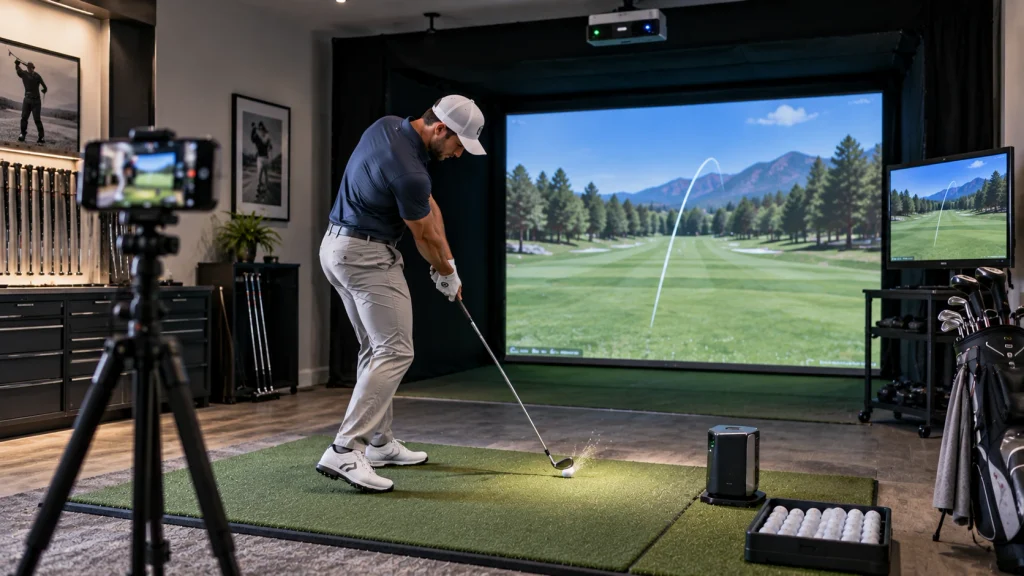
How To Practice Golf Swing At Home Safely
The first step in learning how to practice golf swing at home is making sure you have enough room. Before making a full swing, check the ceiling, walls, furniture, lights, fans, garage-door tracks, windows, and anything else the club could hit. Use your longest club during this safety check because a driver requires more clearance than a wedge or short iron. Start with slow swings and gradually increase speed only when you know the area is clear.
Home practice should still use normal golf equipment that allows you to rehearse realistic movements. The USGA Equipment Rules explain how clubs, balls, and other golf equipment are regulated while emphasizing that success in golf should continue to depend on a player’s skill and practice. When working at home, use equipment that fits your normal game and create enough clearance to swing without changing your natural movement. A safe practice area does not have to be large, but it should let you complete the backswing and follow-through comfortably.
Use A Mirror To Check Your Setup
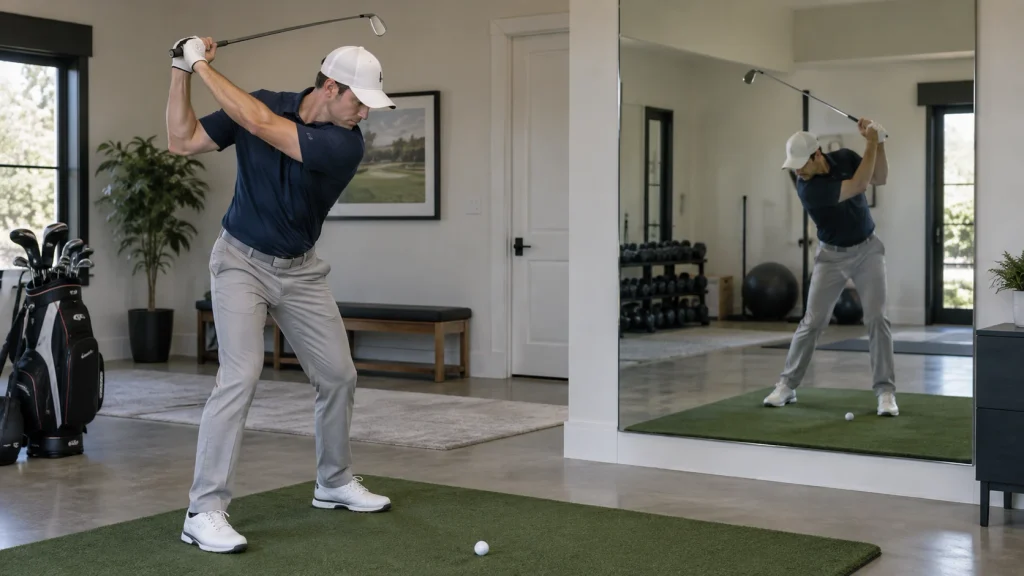
A mirror is one of the simplest tools for home swing practice. Stand in your normal address position and check your posture, knee flex, spine angle, shoulder position, hand location, and distance from the imaginary ball. Small setup changes can affect the entire swing, so practicing these fundamentals regularly can make your motion more repeatable. You do not even need to hit a ball for this type of work to be useful.
When figuring out how to practice golf swing at home in limited space, slow-motion mirror work is especially valuable. Make a backswing while watching where your arms, shoulders, and club move. Then rehearse the transition and finish. PGA instruction also uses mirror-based drills for learning swing positions, particularly when golfers need visual feedback. Avoid trying to copy a position perfectly from a professional golfer. Use the mirror to check whether your own movement remains balanced and consistent.
Practice Your Grip And Address Position
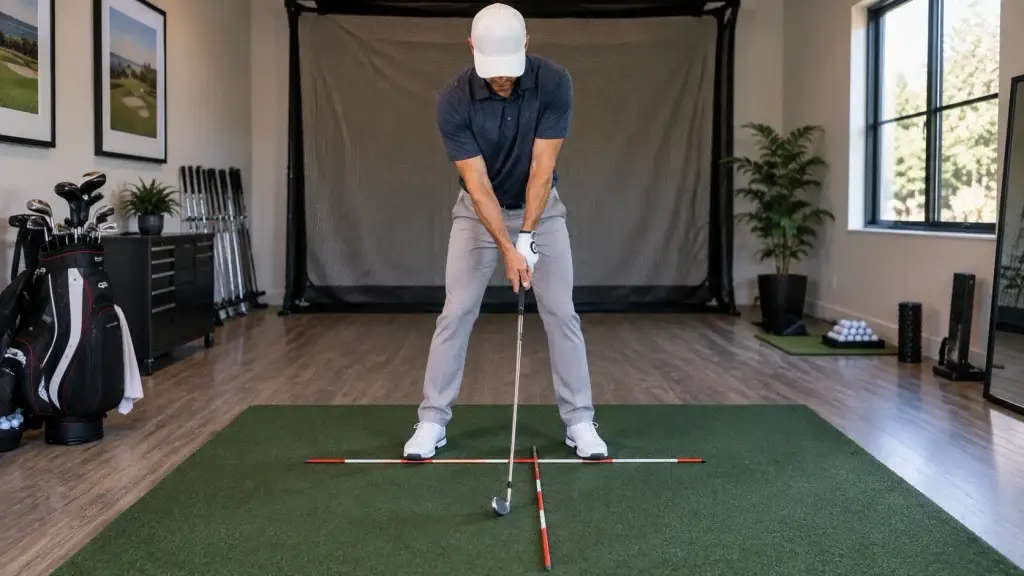
Your swing begins before the club starts moving. Grip pressure, hand position, stance width, ball position, and alignment all influence what happens after takeaway. Home practice gives you an opportunity to repeat these fundamentals without worrying about ball flight. Set up to an imaginary ball several times and check whether your feet, hips, and shoulders are aimed consistently.
This is an important part of how to practice golf swing at home because inconsistent setup can make the same swing produce different results. Use an alignment stick or a straight object on the floor to represent the target line. Place another parallel to it near your feet. This makes it easier to see whether you are accidentally aiming left or right. Repeating the same setup routine also helps create a habit you can use before every shot on the course.
Use Slow-Motion Swings To Improve Movement
Slow swings allow you to feel positions and sequencing that can be difficult to notice at full speed. Make the entire motion at approximately half speed or slower, focusing on balance and smooth transitions. Pay attention to how your body turns, where your weight moves, and whether you finish in control. Slowing the motion down gives you more time to notice where the swing begins to break down.
Anyone learning how to practice golf swing at home can use slow swings even without a golf ball. This is useful when working on takeaway, rotation, weight transfer, or follow-through. You can also pause briefly at certain positions before continuing the swing. Avoid making hundreds of repetitions in one session. Ten deliberate swings with good attention can be more useful than 100 rushed movements. The purpose is to build awareness and consistency, not simply accumulate repetitions.
Work On Balance And Weight Transfer
Balance is essential because the golf swing involves significant rotation and speed. A golfer who loses balance often compensates with the arms or changes the club path to make contact. One simple home drill is to make controlled swings and hold the finish for several seconds. You should be able to remain stable rather than stepping sideways or falling toward the ball.
Weight-transfer drills can also help when working on how to practice golf swing at home. The PGA recommends a step-through drill where the golfer begins with the feet together and steps toward the target during the downswing. The drill helps create the feeling of pressure moving toward the lead side while the body continues rotating. Start slowly and without a ball. Once the movement feels natural, you can progress to normal practice swings or use it as a warm-up before hitting shots.
Hit Into A Practice Net When Space Allows
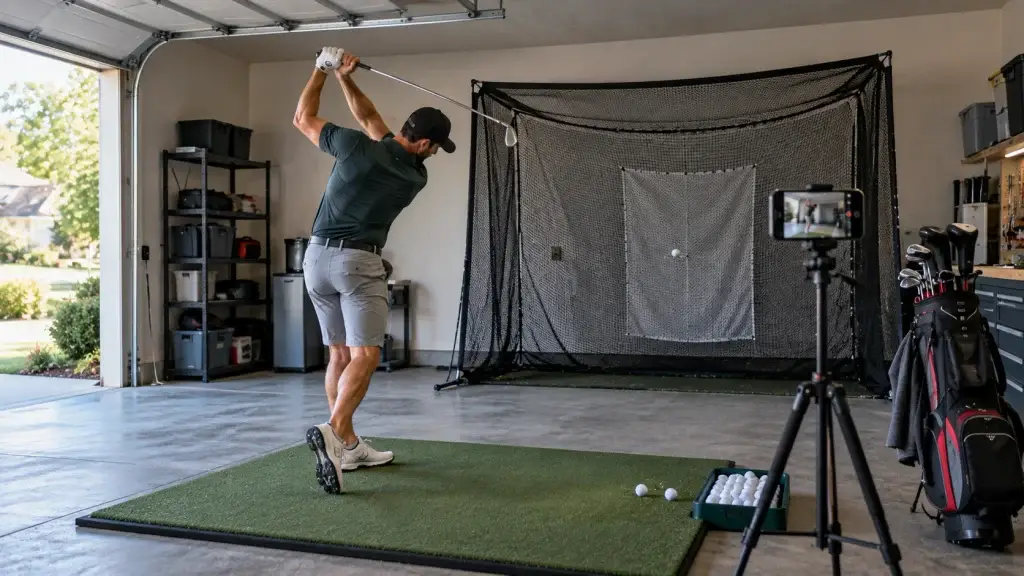
A properly installed practice net allows you to make real golf swings at home without needing a long ball-flight area. Make sure the net is designed for golf balls, securely anchored, and positioned with enough space behind it. Check the surrounding area carefully before using full swing speed. A damaged or poorly secured net can create obvious safety problems.
The limitation of a net is that you cannot see the complete ball flight. This means you need another form of feedback when using it to practice golf swing at home. Impact spray or face tape can show where the ball struck the clubface. You can also record the swing from behind and from the side. Avoid assuming every solid-feeling shot was good. Contact location, start direction, and launch information provide much more useful feedback than feel alone.
Use A Launch Monitor Or Simulator For Feedback
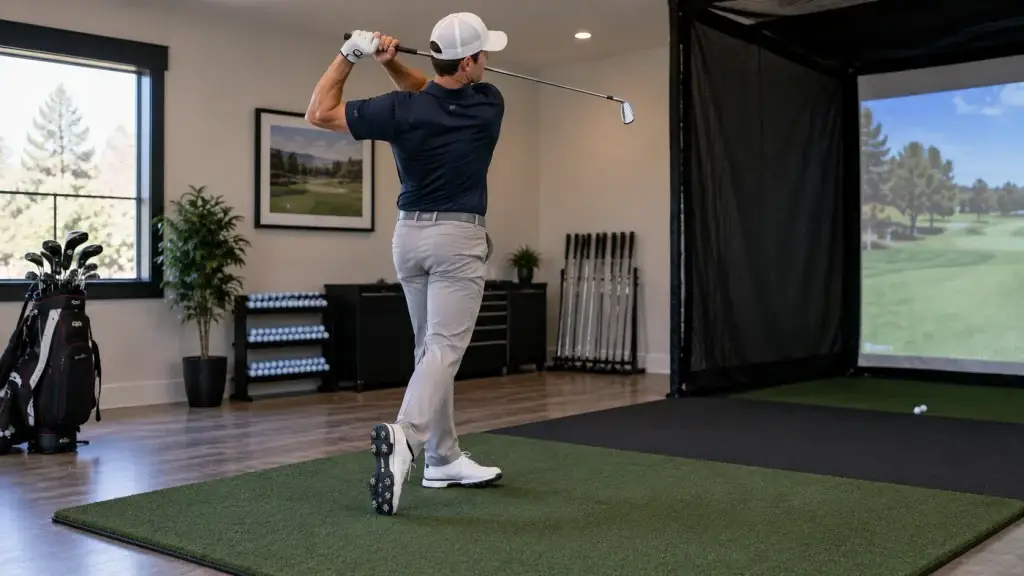
A launch monitor can make home practice more informative because it measures what happens to the ball after impact. Depending on the system, you may see ball speed, launch angle, carry distance, spin, direction, club speed, and other data. This information can help you determine whether a swing change is actually improving performance rather than simply feeling different.
A golf simulator also allows you to practice full shots toward virtual targets and courses. This can make learning how to practice golf swing at home more realistic because every shot has a visible result. Instead of hitting repeatedly into a net, you can aim at fairways, greens, and specific distances. The best approach is to focus on patterns across several shots rather than reacting to every individual number. Consistency matters more than producing one perfect swing.
Build A Repeatable Home Practice Routine
A structured routine makes it easier to improve over time. Start with a short warm-up, then spend several minutes on setup and slow-motion swings. Follow that with one technical drill, several normal practice swings, and full shots if your space allows. Finish by recording a few swings or reviewing your results. Keeping the routine simple helps you practice more consistently.
The PGA recommends setting specific goals and tracking progress during home practice rather than working without a clear objective. If you are learning how to practice golf swing at home, choose one measurable goal for each session. It might be maintaining balance, improving centered contact, or starting more shots on the intended line. Avoid making several major swing changes at once. Focused practice makes it easier to understand what actually helps your game.
Conclusion
Learning how to practice golf swing at home can help you improve without relying entirely on driving-range visits. Mirror work, setup drills, slow-motion swings, balance exercises, practice nets, and launch-monitor feedback can all make home sessions productive. The most important factors are safety, clear goals, and consistent practice rather than simply making as many swings as possible.
Modern technology can make home-style practice even more engaging by combining measured shots with virtual targets and courses. Roaming Scores brings mobile golf simulator experiences directly to events across Northeast Ohio, giving guests a convenient way to hit shots, compete, and experience realistic golf away from a traditional course.